Tuesday, November 23, 2010

Toes in the Water

   After yesterday's sharp decline in the markets and stark reversal thanks to a few high-flying names, the market appeared to be sitting on fragile ground. When North Korea fired several artillery shells at a South Korean island overnight, equity markets dropped across the globe. Combined with fears of European sovereign debt and slowing Chinese demand, the global economic outlook is showing signs of strain. Although Ireland appears to have an EU/IMF bailout in place, all eyes are quickly shifting to Portugal and Spain. As concerns creep back into the marketplace, today marked a strong "risk-off" day.

   For those who have been reading this blog, my outlook for the market the past several weeks has clearly been cautious at best. In the previous post, Optimism Reigns, I went as far as calling for a 5-8% correction in the near future. As equity markets sold off today, the Dow briefly broke below 11,000, marking a nearly 4% drop in just over two weeks. Although I expect the decline to continue for at least another week or two, for the first time in a couple months, buying opportunities are showing up on my watch list. 

   Abbott Laboratories (Ticker: ABT) is a broad-based health care company that discovers, develops, manufactures and markets products and services that span the continuum of care – from prevention and diagnosis to treatment and cure. Abbott's principal businesses are global pharmaceuticals, nutritional and medical products, including diagnostics and cardiovascular devices. Abbott's earnings have grown nearly 27%, on average, the past three years and are expected to increase an average 11% for the next three. On top of earnings growth, the company currently sports a dividend yield of 3.75% and has increased dividend payouts for 38 consecutive years. The stock currently trades for only 10 times forward earnings expectations making it a strong value play and a good buy under $47 (closed at $46.95 today).

   RR Donnelley (Ticker: RRD) provides solutions in commercial printing, forms and labels, direct mail, financial printing, print fulfillment, business communication outsourcing, logistics, online services, digital photography, and content and database management. No question business has been tough due to the recession and a technological shift to online advertising. However, as the largest printer in North America with strong positions across the globe, earnings should improve as advertising picks up. Earnings are forecast to grow about 17% next year while the stock currently trades at just over 8 times forward earnings. The most enticing feature of owning the stock is its current 6.5% dividend yield. RRD closed at $15.97 today and I'd be a buyer below $15.85. 

   Given the murky outlook for economic and equity growth over the next year, the aforementioned stocks offer comparable yields to bonds with potential for further capital gains. As mentioned earlier, the recent downtrend is likely to play out for a bit longer and therefore I'm hesitant to dive in on the long side. At this point, buying a third of a typical position and waiting for further pullbacks would be advised. While the outlook remains rocky, the timing seems right to dip a couple toes in the water.

Disclosure: Investors should do their own analysis of all recommendations to determine their suitability for any portfolio. Long ABT and RRD.
   

Sunday, November 21, 2010

Optimism Reigns

   As we head into a shortened week due to the Thanksgiving holiday, it seems unlikely that market volumes or volatility will be too high. After last week's dramatic decline and massive rise that ultimately moved markets very little, reduced volatility may be a welcome change for many investors. With the final month of the year approaching and many expecting a Santa Clause rally to take hold soon, it appears markets are poised for another year of double digit gains.This news may come as a surprise given that much of the talk the past few months has been about the wall of worry surrounding stocks. Although this talk has been common practice amongst market participants, it may not hold real weight in the investment community.

   A commonly used phrase I'm sure you've heard is that "talk is cheap." One thing I've certainly learned in my lifetime is that words only really matter if a person's actions back them up. These past few months it appears that much of the cautious or negative talk on Wall Street has been just that. A survey of big fund mangers by Bank of American Merrill Lynch recently showed "market sentiment at its most bullish since April 2010." For those who don't recall, April marked the previous highs for the year before fears of European sovereign debt caused equity markets to drop over 15% within several weeks. Although this level of bullishness could be cause for concern, as long as funds are sitting on loads of cash there should still be room to run. Unfortunately, this does not appear to be the case as average cash holdings fell to only 3.5%. If these surveys truly represent large funds on the whole, one has to wonder where future gains will come from.


   Although large investors and funds may already be largely invested, there remains hope that individual investors will finally succumb to recent stock market gains, jumping out of bonds and back into stocks. This shift in allocation is viewed as a potential driver for the next leg of the bull market rally. However, the American Association of Individual Investors (AAII) Sentiment Survey recently found 58% of investors bullish, the highest reading since the market topped out in 2007. While equity fund outflows may continue, given the degree of bullishness in the market, it remains unclear what level would need to persist to bring money back into equities. For anyone who remembers the past few bubbles, it is typically the individual investor that got to the party last. Therefore, any sign this group is coming back to stocks in a meaningful way may be a good sign that the rally is almost over. 


   As the title of this blog suggests, I'm a clear believer that our future economic path will be largely defined by more frequent bubbles and bursts. Given my weak outlook for the real economy, equity markets appear to be setting the foundation for the next bubble. Though this may play out over a couple years, recent bullishness and market gains suggest a pullback may be in order. Despite the nearly 3% drop a week ago, a more meaningful pull back of 5-8% is likely necessary to move sentiment back to typical levels. 


   I've listed a few articles below related to the topic discussed and from which some of my data was found. The articles are listed in order of preference given any time restraints or desire by the readers...enjoy.


The Cliff by John P. Hussman, Hussman Funds
Market Optimism Is Ominous Sign by Breet Arends, Wall Street Journal
Smart Money Is "Selling the News" by Ron Coby, Minyanville 

Thursday, November 18, 2010

An American Icon Returns

   The first half of this week has been more chaotic than any the past few months as QE2, Irish debt and Chinese monetary tightening have weighed on the markets. After falling rapidly yesterday, the stock market managed to maintain the flat line amidst a slight pullback in the dollar and renewed data showing minimal inflation in the U.S. Bond markets in the U.S. have continued their wild ride since QE2 began on Friday. After rising sharply on Monday, yields dropped at the open Tuesday, rallied back and then fell dramatically into the close. Today, yields started the day to the downside then moved lower throughout the morning before making a strong comeback to finish the day moderately higher. Commodities and emerging market stocks have sold off considerably as well in response to forthcoming Chinese tightening and potential price controls. Despite all this news, general conviction remains that this is a much needed correction and I'd agree a few buying opportunities are starting to arise.

   General Motors (GM) greatly anticipated return to the public market has finally arrived. The size of the IPO has been increased substantially and the initial $33 price tag is at the high end of an already heightened range. Considering all the hoopla leading up to tomorrow, it seems likely the stock will shoot upwards when it opens. After the initial hype subsides, likely next week, the real questions will start to be answered. Although some investors recently have opined that GM was merely an unfortunate consequence of the recession, I'd beg to differ. Years before the recession began, GM was saddled with a cost structure equivalent to paying salaries more than twice that of foreign competitors. Due to concessions made to the UAW, retiree benefits were spiraling out of control. At the same time, GM was burdened with several unpopular brands and numerous gas guzzling vehicles that fell out of favor as oil prices soared. Based on these fundamentals, GM's fate may have been sealed before the recession, which merely finished off the job.

   Oddly, the recession may also have been a blessing in disguise for GM. As the country watched in horror as millions lost their jobs, saving the American icon and its couple hundred thousand jobs was imperative. Over the past two years, with government aid, GM has disposed of several brands, written off billions in debt and restructured contracts with the UAW. GM is absolutely a stronger company now than it was before bankruptcy. However, is it so certain that the problems of the past will not come back to haunt the company? As profits roll in and the government ultimately relinquishes its stake, will the UAW not fight for better compensation? If oil rises above $90 or $100, will the current lines of not so fuel efficient vehicles still be in demand? Beyond these questions, trying to predict the future earnings at this time is incredibly difficult. What if cash for clunkers has brought a significant portion of demand from the next couple years forward? For my money, the current hype and high expectations aren't worth the risk of buying in at a potentially terrible price. As interested as I am in the outcome over the next few days, I'll be watching this IPO from the sidelines.

Monday, November 15, 2010

Options Market Offers Contrary Signal

   This past weekend, Barron's ran an article titled In Love With Stocks, Again by Steven M. Sears. The article points out the recent apparent lack of fear in the market through a view of the Options markets. For those less familiar with options, skew refers to the difference in implied volatility between calls (rights to buy stock at a given price) and puts (rights to sell stock at a given price). Skew offers a good way to interpret any current bias in the market. During normal periods skew is positive since stocks tend to fall faster than they rise, implying greater volatility. Sears notes that recently skew has flattened dramatically on the heels of QE2, implying the expectation of reduced downside risk in the market. Although this may be correctly interpreted as a bullish short-term signal, history tells us that when investors believe risk is marginal, the time to sell is near.

   Today was marked by a continuation of the recent reversal in Treasuries. Since announcing QE2, 10-year yields have risen nearly 60 basis points to almost 3%. The sell-off across all maturities has been dramatic since the Fed actually began purchasing Treasuries on Friday. If the Fed's continued purchases cause further sell-offs and rising yields, could they be inclined to cut the program short? What level of inflation or unemployment in the next 8 months could also be cause for a shortened QE program? Although these outcomes seem improbable, at times of such certainty, unexpected events may actually carry the greatest risk.

[b-CBOE-1115]

Sunday, November 14, 2010

Fed Stands in Own Way on Monetary Policy

   Have you heard much about interest on reserves during the past couple years? Well I haven't either, but this little discussed topic may be having enormous consequences for financial markets and our economy. To lay out the groundwork for the argument, it is important to begin by looking at the level of bank reserves within the U.S. financial system and their relation to economic growth and inflation. By law, banks are required to maintain a specific portion (10% in the U.S.) of their deposits in excess reserves. This amount is intended to provide enough emergency funding in the case of a liquidity crisis or bank run for the bank to avoid becoming insolvent. Under normal circumstances including the years preceding the Lehman bankruptcy, banks tend to hold minimal, if any, reserves in excess of those required. These circumstances persist because banks earn zero return on reserves and therefore are better off loaning or investing the funds at any rate greater than zero. Following Lehman's bankruptcy in September 2008, the above normal situation changed dramatically, but not for the reasons many believe.

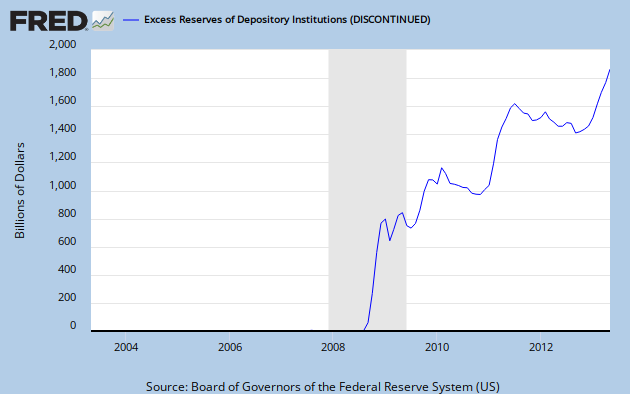
   Prior to the Lehman Brother's bankruptcy, required reserves in the U.S. were around $40 billion and excess reserves were a measly $1.5 billion. However, as credit markets seized up in September 2008, excess reserves began growing rapidly as would have been expected. What was generally unexpected though was excess reserves, which initially peaked around $800 billion in January 2009, not only failed to decrease but have increased after credit markets unfroze (shown below). For the past two years, these massive excess reserves have been used to criticize banks for not lending enough. Although there may be many arguments for why such large amounts of excess reserves have been accumulated, one reason above all others was articulated by a couple staff economists working for none other than the New York Fed itself. The report Why Are Banks Holding So Many Excess Reserves?, by Todd Keister and James McAndrews, argues that the Federal Reserve's decision to pay interest on reserves (IOR) is the primary explanation for the accumulation of reserves.


FRED Graph
    
  
   In October 2008, attempting to thaw credit markets, the Federal Reserve for the first time in its history elected to start paying interest on reserves held at banks. As the Federal Reserve began purchasing assets from banks, reserves piled up and confidence in short-term credit facilities returned. For its original intended purpose, paying interest on reserves appeared to work well. However, as the Fed shifted its priorities from opening up credit markets to jump starting the economy, this policy would prove extremely counter productive.

   While credit markets began to ease in late 2008, the economy was still mired in a terrible recession and confidence was severely lacking. In March 2009, with the stock market plunging to new lows, the Fed announced a new quantitative easing program including purchases of mortgage-backed securities and Treasuries. At the time, the Fed Funds rate, which determines short-term interest rates, was already anchored near the zero bound. Quantitative easing was therefore designed to increase the money supply, driving longer-term interest rates lower and generating greater spending. Lower interest rates by their nature increase the number of alternative investments that would be more profitable, encouraging banks to ramp up lending practices. Each extra dollar added to the money supply is generally expected to create even further growth in the money supply due to a multiplier effect. This basic premise is that banks will lend the extra funds, which once spent end up as deposits in another bank. That bank will lend the excess reserves, above the minimum requirements, and this process will occur many times over until nearly all excess reserves are removed from the banking system. Quantitative easing is therefore expected to enlarge the money supply beyond its initial scope, generating increased consumption and ultimately higher economic growth and inflation.

   The above scenario is what was supposed to happen after QE1 and what is hoped will occur with the establishment of QE2. Unfortunately, if the Fed staff economists are correct (which appears to be the case), the Fed's own policies should be expected to nullify the effects of quantitative easing. As stated in the research report, "if the central bank pays interest on reserves at its target interest rate,..., the money multiplier completely disappears. In this case, banks never face an opportunity cost of holding reserves and, therefore, the multiplier process described above does not even start." To help explain this phenomenon, let's consider the current interest rate environment. The Fed Funds rate is currently being held between 0% and 0.25%, with these rates expected to remain constant for at least a couple years. Based on these rates, Treasury bills and notes ranging from 30-day durations out to a year have generally held within this range. Although these investments are liquid, Treasuries are exposed to interest rate risk. At the same time, the Fed is currently paying interest on reserves equivalent to 0.25% per day and without the same risks. In this real world scenario, the Fed is actually paying interest on reserves above its target rate, affording banks the rare opportunity to earn greater returns with reduced risk. Looking at this scenario, its no wonder why excessive reserves have remained incredibly high and the Fed has been unable to spark inflation. 

   There are a few other interesting takeaways from this discussion. For one, banks have received much criticism for being too stringent in providing loans and for maintaining such large sums of excess reserves. Upon review, it appears that the decision to maintain massive excess reserves is not only entirely rational, but even encouraged by Fed policy. As for the Fed, one has to question if the Fed will ever stop paying interest on reserves in the future. Doing so with current interest rates would likely spark a quick and enormous increase in the flow of funds throughout the global economy. Although this would likely spur economic growth it could also be expected to unleash painfully high inflation. If the Fed continues paying interest on reserves, future decisions to raise the Fed Funds rate above that paid on reserves may risk creating the same problems. For better or worse, the Fed must now consider a new set of variables when making policy decisions for the foreseeable future.