U.S. equity market futures are currently down nearly 2%. Markets across the Middle east sold off earlier, while Asian and European markets looked poised for similar declines. An exaggerated sense of uncertainty is affecting markets even before the true effects of a U.S. sovereign downgrade are known. For many individuals in the investment world, this weekend was likely very busy as investors and asset managers tried to assess the potential consequences and create a game plan moving forward. Much of my weekend was spent in this fashion so I’ll try to lay out the possible repercussions of the U.S. credit rating downgrade and thoughts on how to invest around it.
As surely everyone is aware by this time, Standard and Poor’s (S&P) downgraded the U.S. credit rating from AAA to AA+ on Friday evening. Potential ramifications are beyond complete comprehension, making it relatively easier to think of possibilities within simplified categories. In this sense the following discussion will focus on treasury debt, U.S. dollar exchange rates, states/municipalities, banks/GSEs, money market funds, investment funds and international markets.
Treasury Debt
To many individuals, the most obvious response to the credit downgrade should be a decrease in price of U.S. debt and corresponding increase in yields. While I expect a quick sell off when markets open tomorrow, buyers may soon after swarm the market searching for yield. Despite the downgrade, treasuries still represent the largest and most liquid asset in the world. With most of the developed world experiencing an economic slowdown and increasing risk of disinflation (possibly, deflation), long-term treasuries still represent a safe, solid investment. Maintaining the expectation that 30-year treasury yields will fall to 3% within the next 5 years, entry points above 4% remain ideal.
U.S. Dollar
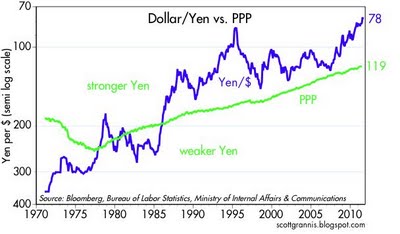
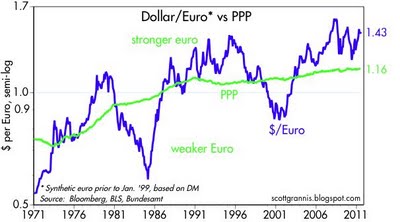
Similar to treasuries, most individuals are probably expecting weakness in the dollar. When currency markets opened this afternoon, the dollar was substantially weaker against most currencies, including the euro and yen. However, when U.S. equity futures opened down sharply, the U.S. dollar rallied back. Regardless of the U.S. credit rating, no other currency options currently exist to replace the dollar as the world’s reserve currency. Tonight, the G-7 vowed to provide liquidity and ensure against disorderly variations in currency exchange rates. Since exchange rates naturally reflect movements of one currency against another, it’s unclear which currencies they will aim to support and at what levels. Either way, central planning is unlikely to be successful for very long. Equity market weakness and increasing fears of deteriorating economic growth will likely push the dollar higher in the coming week.
States and Municipalities
Moving into secondary effects of the rating downgrade is where making judgments becomes far more troublesome. Acknowledging the financial support and backing provided by the federal government to states and localities, many of these entities will likely face downgrades starting tomorrow. While treasuries may be exempt from AAA requirements at various investment funds, it’s unclear whether state and local government debt is treated similarly. Either way, the recent debt limit agreement has made it clear that state government funding will not be increased going forward. Already under budgetary pressure, a number of states and municipalities may face higher interest rates and worsening financial conditions.
Banks and GSEs
Possible outcomes become really interesting in this sector as ratings of several firms are almost certain to be negatively impacted. Many American banks, as well as the GSEs (Fannie Mae, Freddie Mac), currently enjoy somewhat higher credit ratings because of the belief that the federal government would once again bail out debt investors, if necessary. However, S&P notes the following negative consideration in their Sovereign Government Rating Methodology And Assumptions:
Given recent plans to cut federal spending and potential fear of further downgrades, the willingness to bail out these institutions going forward may be reduced. Ratings downgrades for these firms could result in higher capital requirements and some potential forced selling of assets. Already witnessing heavy selling in equity markets the past couple weeks, the pressure may become even more pronounced in the days ahead.
Money Market Funds
Although the long term credit rating of the U.S. was downgraded, the short term rating retained the highest ranking. Treasuries therefore seem unlikely to create any holding issues for these funds. Potential problems could arise if the short term ratings of other investments in bank or GSE paper is downgraded. However, this currently appears to be an area of minimal concern.
Investment Funds
Leading up to the recent market sell off, margin debt on the NYSE was near record highs and cash holdings by mutual funds were near record lows. Investment funds, in general, appear to have been heavily leveraged on the long side after witnessing nearly two years of upwards markets with small pullbacks. Over the past eleven trading days global equity markets fell significantly, with several down over 10%. Further declines could spark margin calls, resulting in forced selling. These circumstances have potential to spiral quickly out of control and feed on themselves in a vicious cycle.
The other primary fear for investment funds stems from potential bylaws requiring a funds’ holdings maintain certain average credit ratings or a specified percentage in AAA-rated securities. Strict bylaws with these constraints have potential to cause forced selling of securities. Many investors have argued that since only S&P downgraded the U.S., bylaws would not be broken (two of three still rate U.S. AAA). Although this may be true, the potential for Fitch or Moody’s to follow suit in downgrading the U.S. (regardless of recent actions) seems fairly high. Asset managers may therefore find it prudent to sell certain holdings in advance of any potential forced selling later on.
International Markets
Recognizing added uncertainty over the coming week, odds seem high that international equity markets will continue selling off. Last week Japan and Switzerland intervened in markets attempting to weaken their respective currencies. The U.S. rating downgrade may increase pressure on those safe-haven currencies again and force further government intervention. Japan, especially, can ill afford an ever stronger yen and maintain hopes of an economic recovery.
Although most discussion within the U.S. has focused on the rating downgrade, some very important news has come out of Europe this weekend. Earlier today Germany says eurozone can't save Italy. In EU Steps Forward, Still Much More Needed, I explained that using the EFSF to support Spain and Italy would require Germany to accept an absurd amount of liability, especially if France were no longer rated AAA. Well, comparing the U.S. and France across many of S&P’s metrics, it appears that downgrade may not be far off. Without France’s AAA rating, the EFSF would be unable to maintain its AAA rating, throwing the whole bailout mechanism into question. Tonight the ECB announced it will purchase Spanish and Italian sovereign debt to stem the crisis. Although they should be commended for following the poem, “if at first you don’t succeed, try, try, try again,” this attempt seems equally doomed to failure. As markets move further into risk-off territory, Europe’s crisis may become increasingly untenable.
Actionable Advice
When I was an options market maker, during times of extreme uncertainty and volatility we always widened out prices. For investors I’d recommend setting limit orders with an extra margin of safety to protect against further downside but take advantage of large moves that present incredible opportunities. While I was certainly bearish on equities with the S&P above 1300, I’m increasingly more constructive in the 1100’s. Over the past two years the market has been led by several high flying stocks that now support price-to-earnings ratios in the stratosphere. Beneath the surface remains numerous securities offering significant yields at reasonable prices. Investors who are currently underweight equities should therefore look to add exposure on further pullbacks.
In spite of its weaknesses, the U.S. remains the most dynamic economy and global safe-haven. Recognition of a global economic slowdown, now recognized, will likely further pressure equity markets to the downside. Europe’s problems continue to worsen with no valid remedy in sight. Japan’s pattern of recurring recessions and deflation continues unabated. China faces prospects of a hard landing as it tries to reign in inflation. As astonishing as it seems, the uncertainty caused by the U.S. downgrade may actually create strength for treasuries and the dollar. For those prepared investors, heightened uncertainty generates the greatest investing opportunities. Get ready for an exciting week!
As surely everyone is aware by this time, Standard and Poor’s (S&P) downgraded the U.S. credit rating from AAA to AA+ on Friday evening. Potential ramifications are beyond complete comprehension, making it relatively easier to think of possibilities within simplified categories. In this sense the following discussion will focus on treasury debt, U.S. dollar exchange rates, states/municipalities, banks/GSEs, money market funds, investment funds and international markets.
Treasury Debt
To many individuals, the most obvious response to the credit downgrade should be a decrease in price of U.S. debt and corresponding increase in yields. While I expect a quick sell off when markets open tomorrow, buyers may soon after swarm the market searching for yield. Despite the downgrade, treasuries still represent the largest and most liquid asset in the world. With most of the developed world experiencing an economic slowdown and increasing risk of disinflation (possibly, deflation), long-term treasuries still represent a safe, solid investment. Maintaining the expectation that 30-year treasury yields will fall to 3% within the next 5 years, entry points above 4% remain ideal.
U.S. Dollar
Similar to treasuries, most individuals are probably expecting weakness in the dollar. When currency markets opened this afternoon, the dollar was substantially weaker against most currencies, including the euro and yen. However, when U.S. equity futures opened down sharply, the U.S. dollar rallied back. Regardless of the U.S. credit rating, no other currency options currently exist to replace the dollar as the world’s reserve currency. Tonight, the G-7 vowed to provide liquidity and ensure against disorderly variations in currency exchange rates. Since exchange rates naturally reflect movements of one currency against another, it’s unclear which currencies they will aim to support and at what levels. Either way, central planning is unlikely to be successful for very long. Equity market weakness and increasing fears of deteriorating economic growth will likely push the dollar higher in the coming week.
States and Municipalities
Moving into secondary effects of the rating downgrade is where making judgments becomes far more troublesome. Acknowledging the financial support and backing provided by the federal government to states and localities, many of these entities will likely face downgrades starting tomorrow. While treasuries may be exempt from AAA requirements at various investment funds, it’s unclear whether state and local government debt is treated similarly. Either way, the recent debt limit agreement has made it clear that state government funding will not be increased going forward. Already under budgetary pressure, a number of states and municipalities may face higher interest rates and worsening financial conditions.
Banks and GSEs
Possible outcomes become really interesting in this sector as ratings of several firms are almost certain to be negatively impacted. Many American banks, as well as the GSEs (Fannie Mae, Freddie Mac), currently enjoy somewhat higher credit ratings because of the belief that the federal government would once again bail out debt investors, if necessary. However, S&P notes the following negative consideration in their Sovereign Government Rating Methodology And Assumptions:
“Contingent liabilities refer to obligations that have the potential to become government debt or more broadly affect a government's credit standing, if they were to materialize. Some of these liabilities may be difficult to identify and measure, but they can generally be grouped in three broad categories:
· Contingent liabilities related to the financial sector (public and private bank and non-bank financial institutions);
· Contingent liabilities related to nonfinancial public sector enterprises (NFPEs); and
· Guarantees and other off-budget and contingent liabilities.”
Given recent plans to cut federal spending and potential fear of further downgrades, the willingness to bail out these institutions going forward may be reduced. Ratings downgrades for these firms could result in higher capital requirements and some potential forced selling of assets. Already witnessing heavy selling in equity markets the past couple weeks, the pressure may become even more pronounced in the days ahead.
Money Market Funds
Although the long term credit rating of the U.S. was downgraded, the short term rating retained the highest ranking. Treasuries therefore seem unlikely to create any holding issues for these funds. Potential problems could arise if the short term ratings of other investments in bank or GSE paper is downgraded. However, this currently appears to be an area of minimal concern.
Investment Funds
Leading up to the recent market sell off, margin debt on the NYSE was near record highs and cash holdings by mutual funds were near record lows. Investment funds, in general, appear to have been heavily leveraged on the long side after witnessing nearly two years of upwards markets with small pullbacks. Over the past eleven trading days global equity markets fell significantly, with several down over 10%. Further declines could spark margin calls, resulting in forced selling. These circumstances have potential to spiral quickly out of control and feed on themselves in a vicious cycle.
The other primary fear for investment funds stems from potential bylaws requiring a funds’ holdings maintain certain average credit ratings or a specified percentage in AAA-rated securities. Strict bylaws with these constraints have potential to cause forced selling of securities. Many investors have argued that since only S&P downgraded the U.S., bylaws would not be broken (two of three still rate U.S. AAA). Although this may be true, the potential for Fitch or Moody’s to follow suit in downgrading the U.S. (regardless of recent actions) seems fairly high. Asset managers may therefore find it prudent to sell certain holdings in advance of any potential forced selling later on.
International Markets
Recognizing added uncertainty over the coming week, odds seem high that international equity markets will continue selling off. Last week Japan and Switzerland intervened in markets attempting to weaken their respective currencies. The U.S. rating downgrade may increase pressure on those safe-haven currencies again and force further government intervention. Japan, especially, can ill afford an ever stronger yen and maintain hopes of an economic recovery.
Although most discussion within the U.S. has focused on the rating downgrade, some very important news has come out of Europe this weekend. Earlier today Germany says eurozone can't save Italy. In EU Steps Forward, Still Much More Needed, I explained that using the EFSF to support Spain and Italy would require Germany to accept an absurd amount of liability, especially if France were no longer rated AAA. Well, comparing the U.S. and France across many of S&P’s metrics, it appears that downgrade may not be far off. Without France’s AAA rating, the EFSF would be unable to maintain its AAA rating, throwing the whole bailout mechanism into question. Tonight the ECB announced it will purchase Spanish and Italian sovereign debt to stem the crisis. Although they should be commended for following the poem, “if at first you don’t succeed, try, try, try again,” this attempt seems equally doomed to failure. As markets move further into risk-off territory, Europe’s crisis may become increasingly untenable.
Actionable Advice
When I was an options market maker, during times of extreme uncertainty and volatility we always widened out prices. For investors I’d recommend setting limit orders with an extra margin of safety to protect against further downside but take advantage of large moves that present incredible opportunities. While I was certainly bearish on equities with the S&P above 1300, I’m increasingly more constructive in the 1100’s. Over the past two years the market has been led by several high flying stocks that now support price-to-earnings ratios in the stratosphere. Beneath the surface remains numerous securities offering significant yields at reasonable prices. Investors who are currently underweight equities should therefore look to add exposure on further pullbacks.
In spite of its weaknesses, the U.S. remains the most dynamic economy and global safe-haven. Recognition of a global economic slowdown, now recognized, will likely further pressure equity markets to the downside. Europe’s problems continue to worsen with no valid remedy in sight. Japan’s pattern of recurring recessions and deflation continues unabated. China faces prospects of a hard landing as it tries to reign in inflation. As astonishing as it seems, the uncertainty caused by the U.S. downgrade may actually create strength for treasuries and the dollar. For those prepared investors, heightened uncertainty generates the greatest investing opportunities. Get ready for an exciting week!