Recently I've been debating which elective courses to take in the coming years and which fields to specialize in. One of the two fields will almost certainly be monetary economics. For the other, I’m currently leaning towards economic history. With that subject in mind, I was pleasantly surprised to stumble across a new paper by Kenneth Carlaw and Richard Lipsey, “Does history matter? Empirical analysis of evolutionary versus stationary equilibrium views of the economy.” (h/t David Glasner) Although I’ve yet to read the full paper, here is the abstract to whet your appetite (emphasis mine):
The evolutionary vision in which history matters is of an evolving economy driven by bursts of technological change initiated by agents facing uncertainty and producing long term, path-dependent growth and shorter-term, non-random investment cycles. The alternative vision in which history does not matter is of a stationary, ergodic process driven by rational agents facing risk and producing stable trend growth and shorter term cycles caused by random disturbances. We use Carlaw and Lipsey’s simulation model of non-stationary, sustained growth driven by endogenous, path-dependent technological change under uncertainty to generate artificial macro data. We match these data to the New Classical stylized growth facts. The raw simulation data pass standard tests for trend and difference stationarity, exhibiting unit roots and cointegrating processes of order one. Thus, contrary to current belief, these tests do not establish that the real data are generated by a stationary process. Real data are then used to estimate time-varying NAIRU’s for six OECD countries. The estimates are shown to be highly sensitive to the time period over which they are made. They also fail to show any relation between the unemployment gap, actual unemployment minus estimated NAIRU and the acceleration of inflation. Thus there is no tendency for inflation to behave as required by the New Keynesian and earlier New Classical theory. We conclude by rejecting the existence of a well-defined a short-run, negatively sloped Philips curve, a NAIRU, a unique general equilibrium, short and long-run, a vertical long-run Phillips curve, and the long-run neutrality of money.
This final statement sets forth very lofty goals that appeal to my biases and probably those of many readers.
Related to economic history, but from a different angle, Lord Keynes presents a historical look at the Austrian perspective on the Government’s Ability to Increase Employment and Output:
Robert Murphy tells us that it is not at all clear that we “should credit QE1 and/or [sc. the] Obama stimulus” with the US recovery in 2009. That reflects a most extreme view that some Austrians can now be found peddling: the idea that expansionary government fiscal policy does nothing or little to increase private investment and consumption, and that government stimulus programs do not work.
How strange it is, then, to see that other Austrians have never denied that government fiscal and monetary policies can increase employment and output.
Take this statement by Huerta de Soto (who is himself an advocate of a most extreme Rothbardian program):
What should be done if, under certain circumstances, it appears politically ‘impossible’ to take the measures necessary to make labor markets flexible, abandon protectionism and promote the readjustment which is the prerequisite of any recovery? This is an extremely intriguing question of economic policy, and its answer must depend on a correct evaluation of the severity of each particular set of circumstances. Although theory suggests that any policy which consists of an artificial increase in consumption, in public spending and in credit expansion is counterproductive, no one denies that, in the short run, it is possible to absorb any volume of unemployment by simply raising public spending or credit expansion, albeit at the cost of interrupting the readjustment process and aggravating the eventual recession.
The whole excerpt from Huerta de Soto includes similar views from Hayek and Lachmann. Due to the current lack of economic history classes in today’s universities, I fear many Austrians will be surprised to learn that government intervention was previously accepted as a short run remedy, albeit with longer run consequences. From the other side, I worry that Post-Keynesians downplay historical lessons about the difficulty and long run costs of ameliorating short run pain.
Regardless of one’s side on the matter, the above posts highlight the benefits of learning and studying economic history (or history of economic thought). The current push to eliminate these courses at most colleges and universities is a huge disservice to the future of economics as a social science (which it inherently is). Hopefully the trend can be reversed, in part, so that I may one day have the opportunity to teach courses in this field.
Friday’s L.A. Times featured an article by UMKC Economics Professor Stephanie Kelton titled, Forget the ‘fiscal cliff’ (h/t Warren Mosler). The article poses an important question, “Why are we worried about balancing the federal budget at all?” Kelton lays out reasons why the government is dissimilar from households and how budget deficits can actually bolster economic growth and employment. Moving toward the conclusion, Kelton says (emphasis mine):
So in our current circumstance — a growing but fragile economy — policymakers are wrong to focus on the fact that there is a deficit. It's just a symptom. Instituting tax increases and spending cuts will pull the rug out from under consumers, thereby disrupting the income-sales-jobs relationship. Slashing trillions from the deficit will only depress spending for year to come, worsening unemployment and setting back economic growth.
While I agree with the majority of Kelton’s insights and conclusion, I emphasized a specific sentence above because it highlights an area where I believe MMT intentionally obscures the truth. To make my disagreement as clear as possible, I am not denying that the federal budget deficit is a symptom of economic circumstances. My critique is that this statement overlooks countless political decisions, before and during the economic crisis, that set in place counter-cyclical spending programs. This does not imply that programs such as unemployment insurance and food stamps are unwarranted. My point is merely that the direction and size of changes to the governmental budget has been and ultimately remains a political decision.
Despite this criticism, Kelton’s conclusion wonderfully counters the political and mainstream media perspective:
The effort to balance the books that's at the heart of the fiscal cliff is simply misguided. Instead of butting heads over whose taxes to raise and which programs to cut, lawmakers should be haggling over how to use the tool of a federal deficit to boost incomes, employment and growth. That's the balancing act we need.
After a brief hiatus from blogging due to final exams and mental recuperation, I’m ready to get back into the swing of things. While I have a ton of reading to catch up, there is one post in particular that I want to share with my readers. During the break, Mike Sax put forth the question, What School of Economics is Woj From?
Speaking of Woj, on a few occasions Nanute has asked me what Woj is-economically speaking. I always answer that he's an MMTer-or Post Keynesian-but Nanute has the impression that he's an Austrian.
Just reading some posts there recently tells me that it's actually a bit of both. Which is interesting-you normally think of MMTers and Austrians to be diametrically opposed antipodes.
This question is personally relevant given my selection of PhD programs and the direction of this blog. Many readers are likely aware of my decision to attend the PhD in Economics program at George Mason University, a school known primarily for promoting Austrian economics. However, readers are also presumably aware that a majority of my blog posts focus on monetary and fiscal policy from a typical Post-Keynesian vantage point. Mike points out something that several colleagues have also picked up on this semester about the Austrian - Post Keynesian dichotomy:
It's a very interesting amalgamation: but I'm not sure how you practically can choose between policy prescriptions if you are both skeptical about government spending for malinvestment reasons and yet agree that fiscal deficits are necessary at least countercylically.
Are these two schools of economics mutually incompatible or are there sufficient overlapping ideas to create a unique vision? Which of the schools do you associate this blog with? Mike does an excellent job laying out some of my views on the topic and hopefully others will chime in here as well. After a few days, I will try to shed some light on Mike and Nanute’s debate with a more comprehensive take on the question from my own perspective.
Related posts:
Finding Common Ground
Hayekian Limits of Knowledge in a Post-Keynesian World
Are Theories of Modern Money and Heterogeneous Capital Compatible?
Post Keynesian and Austrian Perspectives on Heterogeneous Capital and the Capital Debates
1) Europe’s Avoidable Collision Course by Tyler Cowen @ The New York Times (h/t Mark Thoma)
It is thus a mistake to overreact to most of the headline events about the euro zone crisis. The good news is never quite as good as it looks, and the bad news often brings beneficial responses. It seems that for dozens of months now, we’ve been hearing that the fate of the euro zone will be decided “shortly,” yet somehow the drama continues.
Unfortunately, longer-lasting solutions require coordinated agreement among many euro-zone nations and, possibly, the broader European Union. That would include significant debt write-offs (as the International Monetary Fund is suggesting), quick moves toward better-integrated European banking institutions, and a general agreement that the European Central Bank unconditionally support troubled debt securities without trying to manipulate home governments’ policies.
Could all of that happen? For comparison, the current fiscal standoff in the United States involves no more than a president and two houses of Congress. In Europe, however, the bargaining is much more precarious, as it must span numerous nations, many of which have coalition governments, separation of powers and, in the case of Spain and Belgium, significant ethnic and linguistic division. The European Union has even had trouble concluding routine budget negotiations, the disputed parts of which concern no more than 0.03 percent of the union’s gross domestic product.
Woj’s Thoughts - Though I hold some differing views about the feasibility of the European Union with a common currency, in this piece I think Tyler is right on the mark. It has been fascinating and frustrating to watch markets seemingly overreact to every bit of European news. The supposedly best efforts of politicians and economists have, to date, failed to change the direction of economic growth and unemployment in the region. As I’ve stated previously, the clear optimism that remains among markets and Europeans is a positive sign of how deep faith in an eventual resolution lies. The likelihood of that optimism being rewarded is unfortunately minute in the near future and remains unfavorable for the long-run.
2) Mandated Employer Health Insurance Is Biased Against Small Business (in the US) by Peter Dorman @ EconoSpeak
This morning’s story about the problems small business owners face in complying with the ACA doesn’t surprise me. My first gig as an economist, way back in 1979, was a summer internship at the Small Business Administration, where, among other things, I prepared an analysis of the impact of health insurance mandates on small firms. It was a pretty rudimentary piece of work: I was just a grad student and had not yet studied how to do applied micro analysis. Still, I was able to see the main story line.
Actually, I got two out of the three pieces of the story. First, I saw that there are economies of scale in group health insurance, and without some form of organization above the firm level, small employers will pay a higher unit cost. Second, and quantitatively more important, small firms in the US are substantially more labor-intensive on average, so an increase in labor costs hits them harder. The third piece, which I missed at the time, is that wages are lower in the small business sector, so a mandated benefit of given cost will constitute a larger share of the wage bill.
…
But the US suffers tremendously from duality*—the division in the economy between larger, better-capitalized, more productive, higher-paying operations and smaller, less productive sectors that offer crummy jobs. (It isn’t entirely a division between firms because some large firms have established their own internal “secondary” sectors.) ACA should be examined in this context, especially since the administration hasn’t proposed any measures at all to reverse the trend toward greater duality, which is one of the underlying factors behind the growth in inequality.
Woj’s Thoughts - The other day I offered thoughts on Furthering the Post-Keynesian View of Wealth and Income Concentration, which entailed some great discussion within the comments. A question that I posed regarding a Job Guarantee is, how will it interact with the current market structure? The above post suggests a similar approach should have been considered with the ACA. Yes it will increase access to health insurance, but what if it also leads to larger unemployment and inequality? There is no question that trying to quantify these effects is difficult and imprecise, at best. The end result may have even been the same. All I’m saying is that I would generally prefer to see these macro-policy decisions examined in a broader context.
3) Conflicting signals on dollar-yen by Walter Kurtz @ Sober Look
Clearly investors have some good reasons to continue shorting the yen, as fundamentals for the currency are terrible. The BOJ balance sheet as percentage of GDP is at a record.
Source: Merrill Lynch
…
Based on these fundamentals Merrill obviously predicts a weaker yen. As one would expect, monetary expansion is unlikely to improve credit, but it should impact the FX markets.
Woj’s Thoughts - Obviously many people have been trying, unsuccessfully, to short the Yen for a long time. The BOJ's efforts to create inflation have been equally unrewarded. I continue to think that until the government pledges and follows through on a massive fiscal stimulus (deficit increases), the economy will remain stagnant and the Yen will remain a strong safe-haven.
Tyler Cowen asks us to ponder the following sentences:
This first figure shows that aggregate demand growth has not been affected by a tightening of fiscal policy since 2010. Specifically, it shows that nominal GDP (NGDP) growth has been remarkably stable since about mid-2010 despite a contraction in federal government expenditures.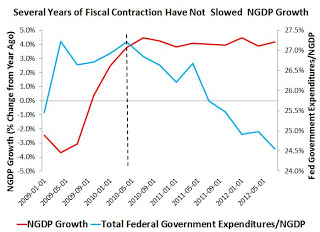
Those sentences are from prominent Market Monetarist and NGDP Targeting proponent David Beckworth. His conclusion based on the above graph and a similar one depicting the declining budget deficit is that:
Both figures seriously undermine the argument for coutercyclical fiscal policy and suggest a very a low fiscal multiplier. They also indicate that the Fed has been doing a remarkable job keeping NGDP growth stable around 4.5%. Monetary policy, in other words, appears to be dominating fiscal policy in terms of stabilizing aggregate demand growth.
Trying to find support for Beckworth’s claim, I thought a brief look at how changes in the money supply over the past couple years compare with NGDP might do the trick. Here’s what I found: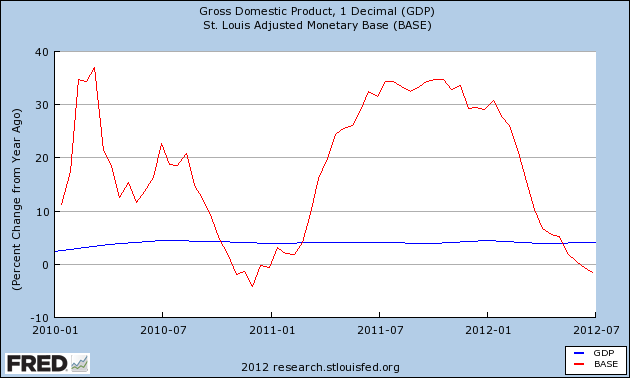
The above chart shows that NGDP has been largely unaffected by both severe tightening and expansion of monetary policy since 2010. Looking at M2 versus NGDP growth displays a similar story: 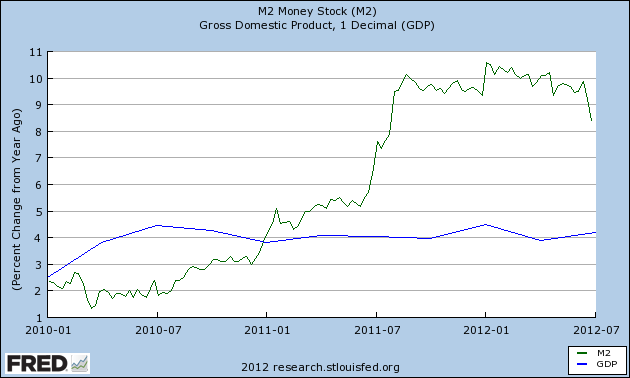
Both charts suggest that changes in the money supply have little impact on NGDP growth. Given that percent changes in either money supply measure are far greater than those of recent fiscal policy, one might conclude that monetary policy has a smaller multiplier than fiscal policy.
Based on the above charts, which conclusion should we accept? Or are both fiscal and monetary policy ineffective? The reality is that all of these charts tell us very little about the causation between either fiscal or monetary policy and NGDP. Noah Smith says it best:
Beckworth's conclusion is not necessarily valid, and illustrates the danger in drawing conclusions about structural variables from looking at correlations between macroeconomic aggregates. Here's why the conclusion might not be valid:
Suppose that Keynesian demand management policy works perfectly: in other words, fiscal stimulus perfectly smooths fluctuations in aggregate demand. In that case, you will observe substantial swings in fiscal policy, but no swings whatsoever in aggregate demand. When external shocks push AD up, fiscal tightening will push it back down; when external shocks push AD down, fiscal policy will push it back up.
…
To conclude: The graphs Beckworth shows are perfectly consistent with a large fiscal multiplier. In fact, they are perfectly consistent with the hypothesis that monetary policy is essentially ineffective, that the Fed is basically powerless, and that fiscal policy is capable of doing a perfect job of smoothing NGDP growth all on its own.
Smith’s conclusion similarly applies to the charts depicting Monetarist demand management policy. The point is that these graphs can be subjectively interpreted to support fiscal policy, monetary policy, or neither. These charts may appease proponents of the respective camps, but far more and better empirical data will be necessary to actually change any minds.
Update: A reader asks for a chart depicting M1 versus NGDP during this period. Always trying to oblige my readers' requests: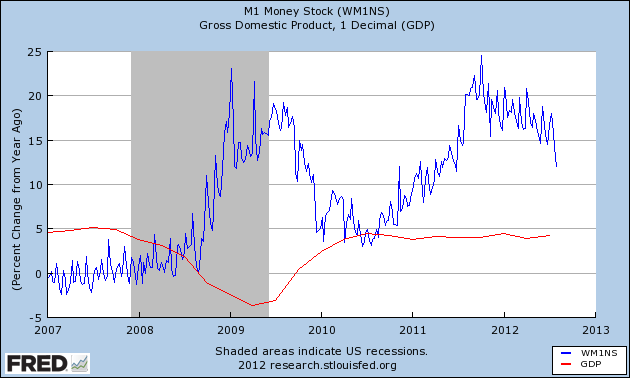
If monetary policy affects NGDP, this chart doesn’t reflect it.

